
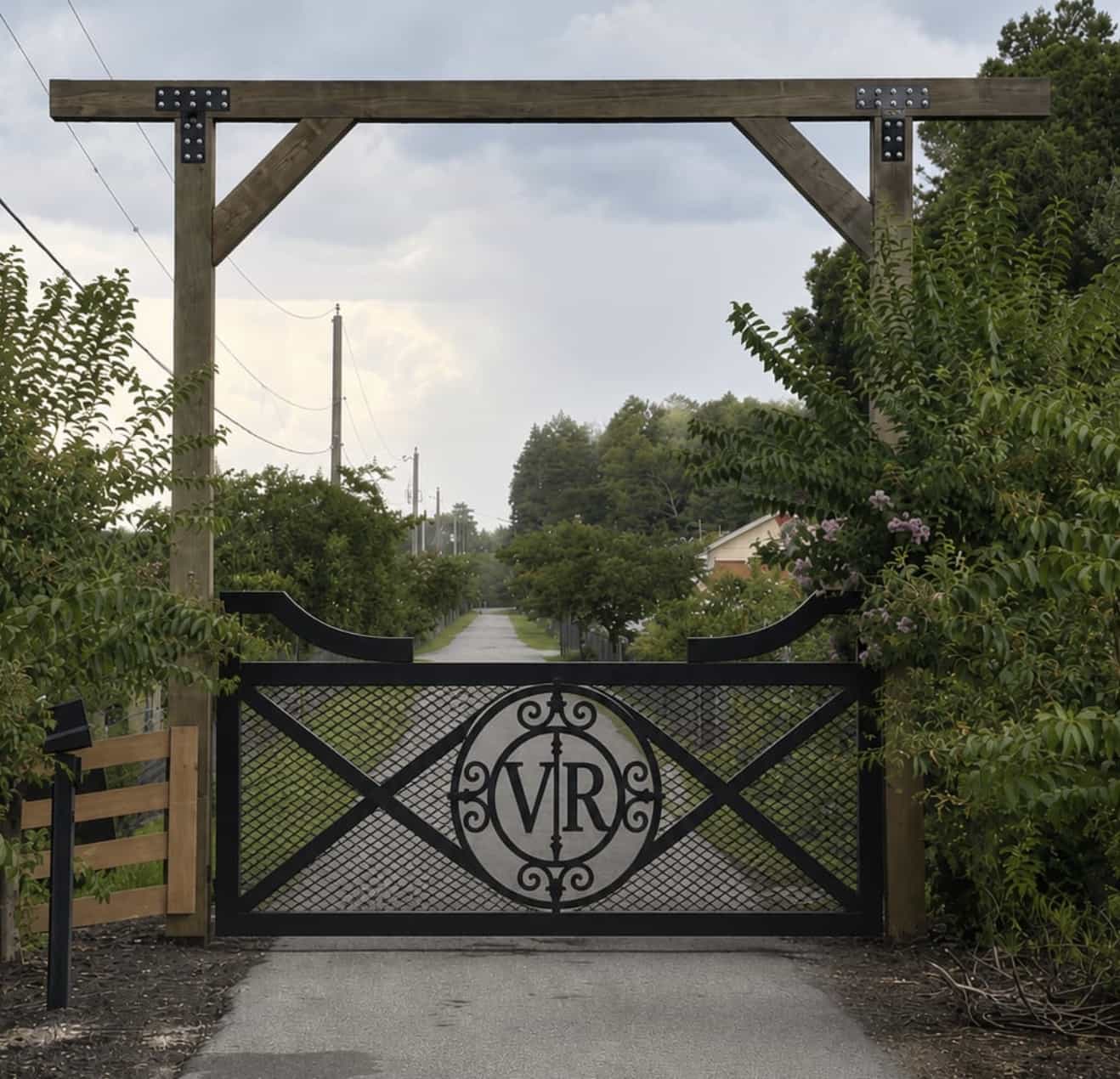
A gate starts by scraping the driveway in one spot. Then the latch needs a lift to catch. Then it needs two hands. By the time someone calls us, the gate has usually been sagging for a year and the owner has already tried shimming the hinge.
Sag is not really a gate problem. It is a leverage problem, and leverage is unforgiving: a twelve-foot gate hanging off one side puts an enormous rotating force on the post and hinges every second of every day, whether anyone is opening it or not. Fixing the symptom without fixing the leverage buys you a few months.
The four real causes
The post is losing the argument
This is the most common one and the most expensive to ignore. A gate post is not holding weight down — it is resisting a constant tipping moment. If the post is undersized in wall thickness, not set deep enough, or set in a footing too small for the soil, the post itself leans. You can measure this: sight down the post from the side. If the top has tilted toward the gate, no amount of hinge adjustment will help, because the gate is level relative to the post and the post is not level relative to the ground.
Hinges rated for the wrong weight
Gate hinges carry a load rating, and a lot of gates go up on hardware chosen because it looked substantial. Barrel hinges wear oval, weld-on hinges tear at the tack, and light-duty hardware on a heavy gate simply gives up. When we rebuild, hardware gets sized to the actual weight of the gate, not to what looks right.
No brace, or a brace running backwards
A rectangular gate frame is not rigid on its own — push on one corner and it turns into a parallelogram. It needs a diagonal, and which direction that diagonal runs matters. The two systems are opposites:
- A rigid steel brace works in compression and must run from the top of the hinge side down to the bottom of the latch side.
- A cable or turnbuckle brace works in tension and runs the other way: from the bottom of the hinge side up to the top of the latch side.
Install one in the wrong orientation and it does nothing but add weight — a mistake we see on roughly a third of the sagging gates we look at.
Infill that got heavier than the frame
People add privacy slats, sheet panels, or a decorative centerpiece years after a gate went up. The frame and hinges were sized for the original weight. Adding twenty pounds at the far end of a twelve-foot gate is not adding twenty pounds — it is adding twenty pounds times a very long lever arm.
Florida adds wind
A solid-panel gate is a sail. On the Gulf Coast that matters twice: once for the peak load during a storm, and again for the thousands of moderate gusts in between that work a joint back and forth until it cracks. This is a real argument for mesh, slat, or picket infill rather than solid sheet on a wide gate, and for hardware and posts sized with wind in mind rather than just dead weight.
Repair or rebuild
Not every sagging gate needs replacing, and we will say so. If the post is sound and the frame is straight, re-squaring the frame, adding a correctly oriented brace, and upgrading the hinges is a genuine repair that lasts. If the post has tilted or the frame has rusted through at the bottom rail, patching it is spending money on a countdown. We tell you which one you have before quoting.
Send photos of the gate, the hinge side, and the base of the post through our contact page and we can usually tell you a lot before we ever drive out. See our gates and fences work and finished gates in the gallery. Repairs are also handled under welding repairs.
Common questions
- Can a sagging gate be repaired, or does it need replacing?
- It depends on the post. If the post is still plumb and the frame is straight, it can be re-squared, braced diagonally and fitted with better hardware. If the post has tilted or the frame has rusted through, rebuilding costs less than patching it twice.
- Why does my gate drag worse at certain times of year?
- Almost always ground movement around the post footing as soil moisture changes, combined with an undersized footing. The gate did not change; the post is moving with the ground.
- Which way should the diagonal brace run?
- A rigid steel brace runs from the top of the hinge side down to the bottom of the latch side, working in compression. A cable with a turnbuckle runs exactly the opposite way, working in tension. Reversed, it does nothing.
Related services
Keep reading
- MaterialsSalt Air and Rust: Why Florida Eats Outdoor MetalIt is not bad luck and it is usually not bad steel. The five places rust always starts, and the cheapest maintenance that genuinely works.
- How We WorkMobile Welding: What to Expect When We Come to YouWhat can be done in your driveway, what belongs in a shop, and the four things that turn a vague phone call into an accurate quote.
- RepairCracked Trailer Frame? Here's What a Real Repair InvolvesLaying a bead down the visible crack is the most common bad repair we see. Here is why it fails, and the three steps that make a fix hold.