
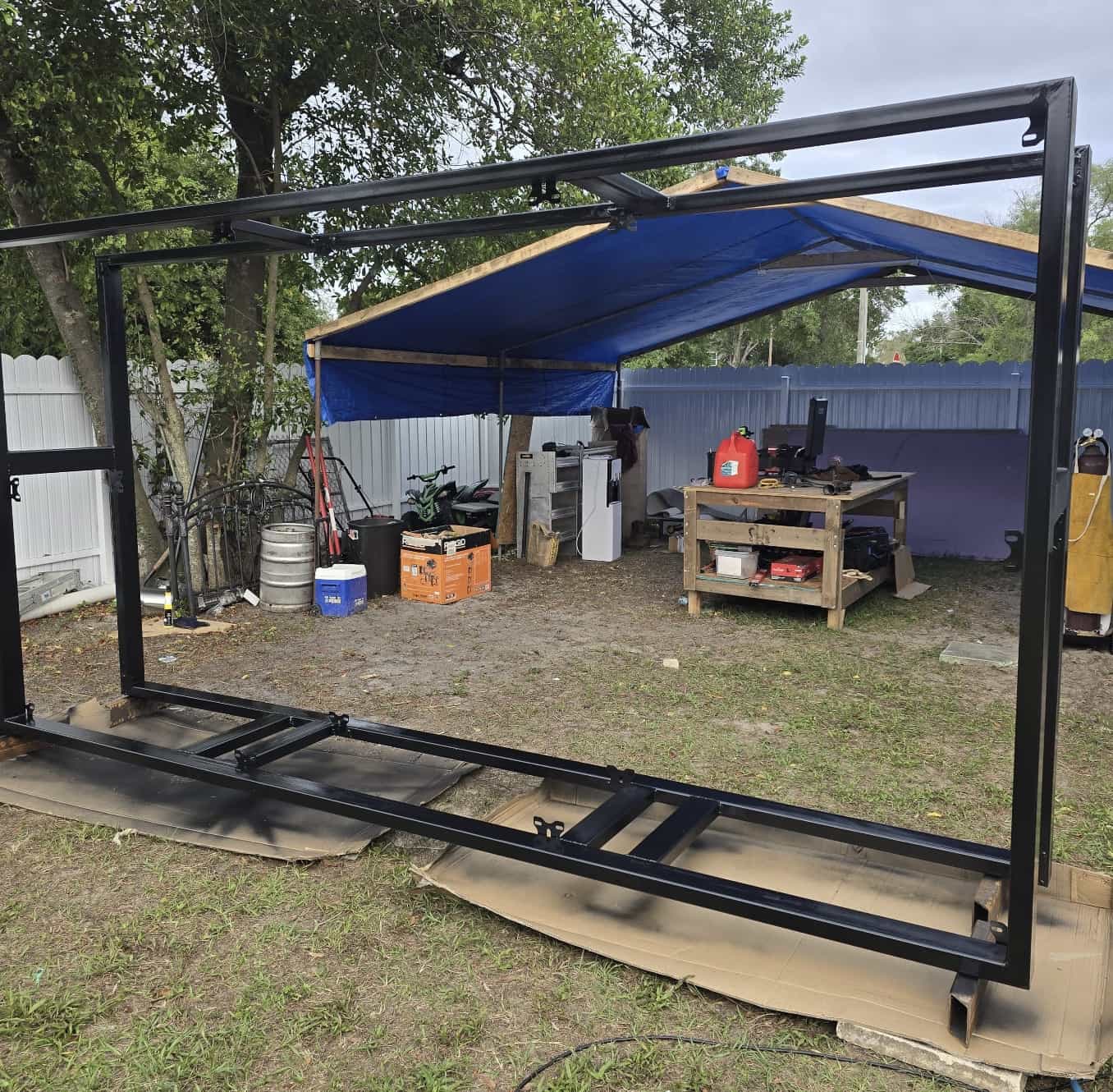
Anyone who has owned a railing, a gate, or a trailer on the Gulf Coast has watched the same thing happen. The piece looks perfect for two years, then a brown streak appears somewhere specific, and within a season it is running down the whole post. That is not bad luck and it is usually not bad steel.
It is not just the salt
Three things have to be present for steel to rust: iron, oxygen, and water. Florida supplies the last two generously. What makes coastal exposure worse is not that salt causes rust — it is that salt dissolved in a film of moisture makes that film electrically conductive, which lets the corrosion reaction run much faster. Salt is also hygroscopic, meaning salt deposits pull moisture out of humid air and stay wet long after a surface looks dry.
Then add time-of-wetness. In Tampa Bay, high humidity plus daily temperature swings means metal spends real hours every night below the dew point, wet, whether or not it rained. A piece of steel here is simply wet for far more hours per year than the same piece in a dry climate. That is the real multiplier.
The five places rust always starts
The weld and the zone beside it
Welding burns off any coating for inches around the joint, and the heat-affected zone next to the bead has a different microstructure than the base metal. If a fabricator welds and then paints without cleaning slag, spatter, and burned coating out of that area, rust starts there first — which is why people conclude "the welds are failing" when the welds are fine and the finish was never right.
Cut edges and drilled holes
A saw cut or a drilled hole exposes bare metal, and paint sprayed over a sharp edge pulls thin as it dries. Sharp corners are the classic first rust point on an otherwise good coating job. Breaking the edge slightly before coating makes a real difference.
Inside the tube
Square and round tube used for posts, gates, and railings is hollow, and if the ends are open, humid air gets in and condenses. The piece then rusts from the inside out, invisibly, until the bottom rail perforates. Sealing the ends properly, or providing a deliberate weep hole at the low point so trapped water can escape, is the difference between a fifteen-year rail and a five-year one.
Where two different metals touch
Stainless hardware run through aluminum, or a steel fastener into an aluminum frame, sets up a galvanic cell in salt-laden moisture. The less noble metal — usually the aluminum — corrodes preferentially around the joint. Isolation with non-conductive washers, bushings, or a barrier sealant at assembly prevents it. Trying to add isolation later, after corrosion has started, rarely works well.
Where water sits
Any horizontal surface, ledge, or pocket that holds a puddle stays wet far longer than a vertical face. Design that drains beats design that traps, every time.
What actually slows it down
Preparation matters more than the paint. Mill scale, slag, spatter, and grinding dust have to come off, because a coating over contamination is a coating waiting to blister. After that, a zinc-rich primer or cold galvanizing compound on bare steel gives real sacrificial protection at the spot that needs it most — repairs and weld zones. Then a topcoat rated for exterior exposure.
The cheapest maintenance that actually works: fresh water. Rinsing salt off railings, gates, and trailers, especially after any exposure near the water, removes the deposits that keep the surface wet. It is unglamorous and it works.
Choosing the material up front
Coated carbon steel is strong and economical and is the right choice for plenty of Tampa Bay jobs, as long as the coating is maintained. Aluminum does not rust — it forms a stable oxide that protects itself — which makes it worth the higher material cost for boat trailers, dock hardware, and anything regularly wet with salt water. Galvanized steel sits between them. Which one is right depends on where the piece lives and who is going to maintain it, and that is a conversation worth having before anything is cut.
If you have a rail, gate, or trailer showing rust and you are deciding between repairing and replacing, send photos — including a close-up of the worst spot and one of the base or bottom rail. See our aluminum welding, gates and fences, and handrail work, and finished projects in the gallery.
Common questions
- Should I use aluminum or steel near the water?
- Aluminum does not rust and is usually worth its higher cost on boat trailers, dock hardware and anything regularly wet with salt water. Coated steel works perfectly well further inland as long as the coating is maintained.
- Why does rust always come back at the weld first?
- Because welding burns the coating off around the joint and leaves slag and spatter behind. If that zone is not cleaned and re-coated with a zinc-rich primer, it is the bare spot everything starts from.
- Can a rusted railing be repaired or does it need replacing?
- If the rust is surface-level and the metal still has sound thickness, it can be cleaned, welded where needed and re-coated. If the tube has perforated from the inside it has lost section, and the honest answer is to replace that piece.
Related services
Keep reading
- How We WorkMobile Welding: What to Expect When We Come to YouWhat can be done in your driveway, what belongs in a shop, and the four things that turn a vague phone call into an accurate quote.
- RepairCracked Trailer Frame? Here's What a Real Repair InvolvesLaying a bead down the visible crack is the most common bad repair we see. Here is why it fails, and the three steps that make a fix hold.
- DiagnosisWhy Driveway Gates Sag — and What Actually Fixes ItSag is not a gate problem. It is a leverage problem — and leverage is unforgiving. The four real causes, and how to tell repair from rebuild.